Most small business owners treat branding like something they’ll deal with later. “After I have steady revenue.” “After things calm down.” “After I feel more established.” After, after, after.
I did the opposite with BrewBoat Cleveland. From day one, I built and marketed it like it could expand to multiple waterfront cities, even though I never planned to franchise. That single decision changed how everyone engaged with the business. Customers, media, city officials, vendors (even the Coast Guard) took us more seriously. It’s a big reason the business sold successfully in 2021.
Building for Scale (Even if You Stay Small)
Franchises operate consistently because they remove uncertainty. You know what you’re getting before you walk through the door. The brand shows up the same way everywhere and the experience doesn’t depend on whether the owner is working that day.
Small businesses can do this too. You don’t need 50 locations or a corporate playbook. You just need to stop leaving your brand and customer experience to chance.
Lessons from the Water: Systems for a Self-Sustaining Business
Applying a franchise mindset isn’t about being ‘big corporate;’ it’s about not treating every task as a one-off so you can focus on where the business is going rather than just keeping it afloat.
Set the Standard
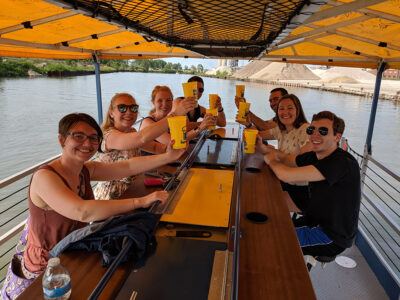
I often wonder how many of these branded cups are still floating around in people’s kitchens…
At the very beginning (before the first boat even hit the water), I created a full logo suite, color guidelines and brand standards that staff, vendors and partners could follow without asking me first. Even our souvenir cups matched the system. This wasn’t about looking polished. Building a brand system anyone could execute meant I stopped being the bottleneck for every design decision.
Script the Experience
We trained staff on exactly how to welcome guests and what language to use. We didn’t just want good service; we wanted the same great customer experience every time. That positive predictability became our marketing engine. People came back because they knew what they’d get and they told their friends for the same reason.
Build Marketing Assets That Last
Yes, it helps that I’m an experienced web designer, but I invested in a website with a simple booking process, licensed software that automated repetitive tasks and relationships with local media that lasted years. By year three, sharing news meant texting a reporter I’d worked with multiple times. Then I just refined and reused the same marketing materials instead of starting over each season.
Hand Over the Keys
The ultimate goal was a business that didn’t require me to be the “everything officer.” Early on, I spent hours crafting every social post and answering every phone call. But for the business to grow, I had to move from doing the work to managing the system. Gradually, I stepped back. Staff posted on social once they understood the guidelines and I delegated phone duties. The business had to function without me hovering or it would never grow beyond what I could manage personally.
The Payoff: Professional Respect and a Successful Exit
As a result of implementing these systems, people treated us differently and the business began to transform.
Media started reaching out to us because we were easy to work with. Software vendors asked us to beta test new features. Coast Guard inspections went smoothly because our documentation was organized and our processes were clear.
The business worked alongside me instead of requiring me to hold it together. And when I eventually said bon voyage to the BrewBoat, that independence mattered to buyers.
The Operational Check-In
You don’t need to own a fleet of boats or be eyeing multiple locations to start thinking this way. Even if you want to stay exactly the size you are, these systems ensure your business can maintain its high standards without requiring your constant personal intervention. To determine if your operation is as solid as it could be, you just need to be honest about whether you are navigating with a plan or simply reacting to the daily waves.
Ask yourself:
- Can someone new execute your marketing without constant check-ins?
- Does your brand look consistent across your website, social media and physical materials?
- Do customers have the same experience regardless of which crew member is working?
- Could you step away for a week without your marketing (or the business) grinding to a halt?
If most of your answers are “not yet,” you’re at the stage where taking a “franchise approach” to your operations matters more than just working harder.
At JumpStart, we see it all the time—talented business owners trapped by their own success because they haven’t built the infrastructure to support it. Without a formal process, marketing becomes an afterthought, branding loses its edge and the customer experience changes from one shift to the next.
JumpStart’s small business programs and workshops can help you identify and implement systems to make your operation more resilient and much easier to manage.
Explore our small business tools and start building a business that’s set up for long-term success.
Share This Article With Your Network!