Not every sale is worth making. Before you say yes to an opportunity, you need to know whether it actually makes you money. A simple customer ROI calculator can cut through the noise fast.
Determining profitability requires looking at revenue (What will the customer pay you?), cost of goods sold (What does it take to deliver on your promise?) and customer acquisition costs (What did you spend to win their business in the first place?).
Whatever’s left is your contribution. Divide that by revenue and you get your contribution margin — a clean percentage that lets you compare any two deals side by side. For example:
| Revenue | $1000 |
|---|---|
| Cost of Goods Sold | $500 |
| Customer Acquisition | $1,000 |
| Contribution | ($500) |
| Contribution Margin | -50% |
In this scenario, losing $500 on a sale is an easy no. But what if the customer buys repeatedly? And what if your marketing spend brought in more than one customer? Say you laid out $2,000 on travel and a conference to land two customers who each order $300/month for six months.
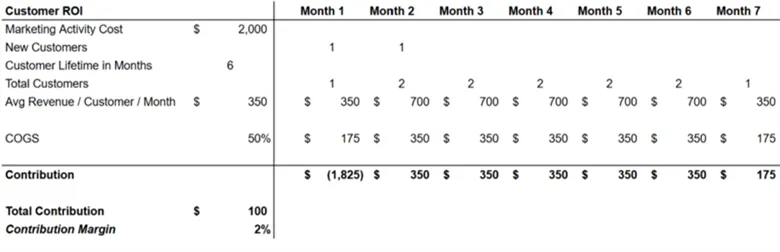
These calculations show two customers don’t cover the time and expense. You’d need at least three to make the investment work to your advantage.
What if a single customer wants to place a large order? There’s no acquisition cost, but there’s a catch — they won’t pay until 90 days after delivery, so financing costs come into play. Here’s what that deal could look like:
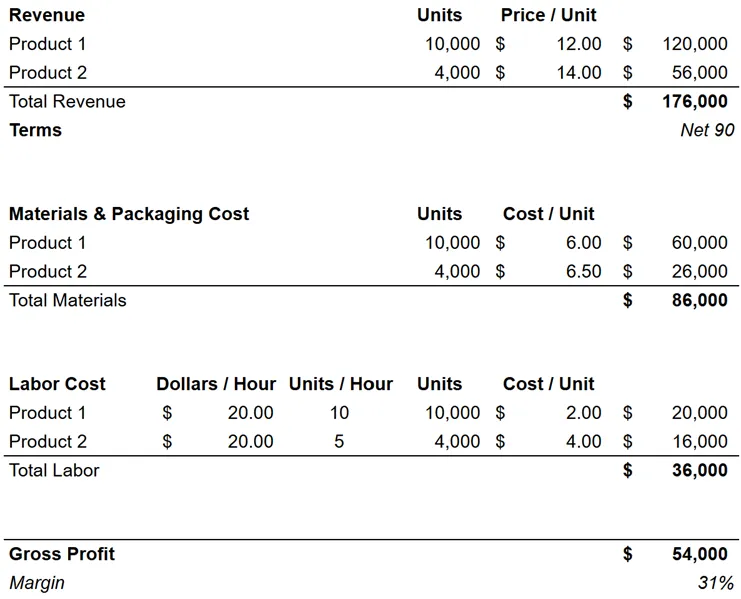
It would be great to pocket $54,000, but since you don’t have $86,000 for materials and $36,000 for labor on hand, you’ll need a line of credit to bridge the gap. The question is whether interest eats the deal.
You draw down $98,000 in February, $12,000 each in March and April. The interest payments along the way are manageable — covered by cash reserves or an owner equity injection. Then in July, the customer pays.
The result? Interest reduces your margin by just 2%, leaving nearly $52,000 in contribution to cover overhead and pay the owner. The deal works — as long as your balance sheet is clean enough to qualify for that line of credit.
Every deal has its own wrinkles. These examples cover some of the most common variables — repeat purchases, shared acquisition costs and financing costs — but your situation may have others. These calculators work best with larger, individual customers where the numbers are simply more meaningful. If you sell to consumers, the same logic applies: focus on average order value, purchase frequency and how long a typical customer sticks around.
The math is straightforward. The variables aren’t always. Run the numbers on every deal before you commit — the best salespeople know which ones to walk away from.
Share This Article With Your Network!